
STANDING ON THE SHOULDERS OF GIANTS
Herbert A. Simon on Focus & Mastery
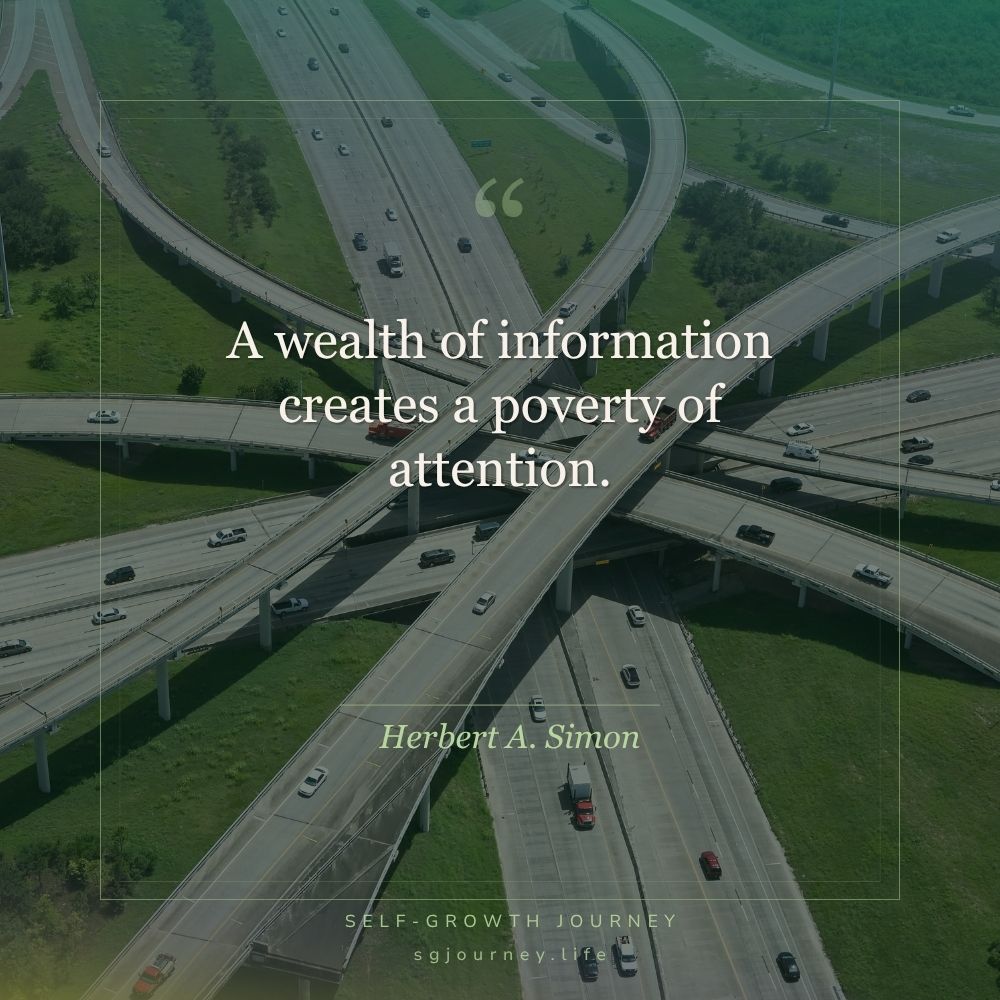
A wealth of information creates a poverty of attention.
—Herbert A. Simon
Nobel Prize-winning scholar who explained why abundant information makes attention scarce
SHARE THE WISDOM
Who Is This Giant?
Herbert A. Simon
Herbert A. Simon was an American economist, political scientist, cognitive psychologist, and computer science pioneer. He received the Nobel Memorial Prize in Economic Sciences for research on decision-making within organizations. Simon's work on bounded rationality and information helped establish a crucial modern insight: when information grows abundant, human attention becomes the scarce resource.
Understanding the Message
Information becomes less useful when its volume exceeds our ability to attend to it. Herbert Simon’s observation identifies the scarce resource hidden inside an information-rich environment: every article, message, notification, report, video, and data point competes for the same limited human attention.
More information therefore does not automatically produce better understanding. Beyond a certain point, additional input can make it harder to distinguish what matters, hold ideas long enough to examine them, or make decisions without continually discovering one more thing to consider. Abundance creates a filtering problem.
This changes the skill required of an informed person. Gathering information remains important, but so do selection, prioritization, and stopping. We need criteria for deciding which sources deserve attention, what level of knowledge is sufficient for the decision at hand, and which incoming information can safely be ignored.
Attention becomes valuable precisely because information is plentiful. The challenge is no longer simply gaining access to knowledge; it is protecting enough mental space to process the knowledge worth having. In an environment capable of supplying endless input, choosing what not to consume becomes part of thinking well.
Making It Personal
Digital life makes information extraordinarily easy to acquire and extraordinarily difficult to finish acquiring. There is always another source, update, opinion, or piece of context available.
Without deliberate limits, consumption can replace understanding. We continue gathering because gathering feels productive, while the attention needed to reflect, decide, or create is gradually exhausted.
Managing information therefore means managing attention. Curating sources, reducing unnecessary inputs, and deciding when we know enough can preserve the mental capacity to do something meaningful with what we have learned.
Look Within
What stream of information currently consumes more attention than the value it gives you? What limit, filter, or stopping rule could help you preserve more attention for actually using what you learn?
A Thought for the Road
When information becomes abundant, the ability to choose what deserves attention becomes increasingly valuable.
Source & Attribution
Herbert A. Simon, “Designing Organizations for an Information-Rich World” (1971)
Verified
Explore What Comes Next
Continue exploring the people, ideas, and pillars behind this wisdom.