
STANDING ON THE SHOULDERS OF GIANTS
Bertrand Russell on Mindset & Perspective
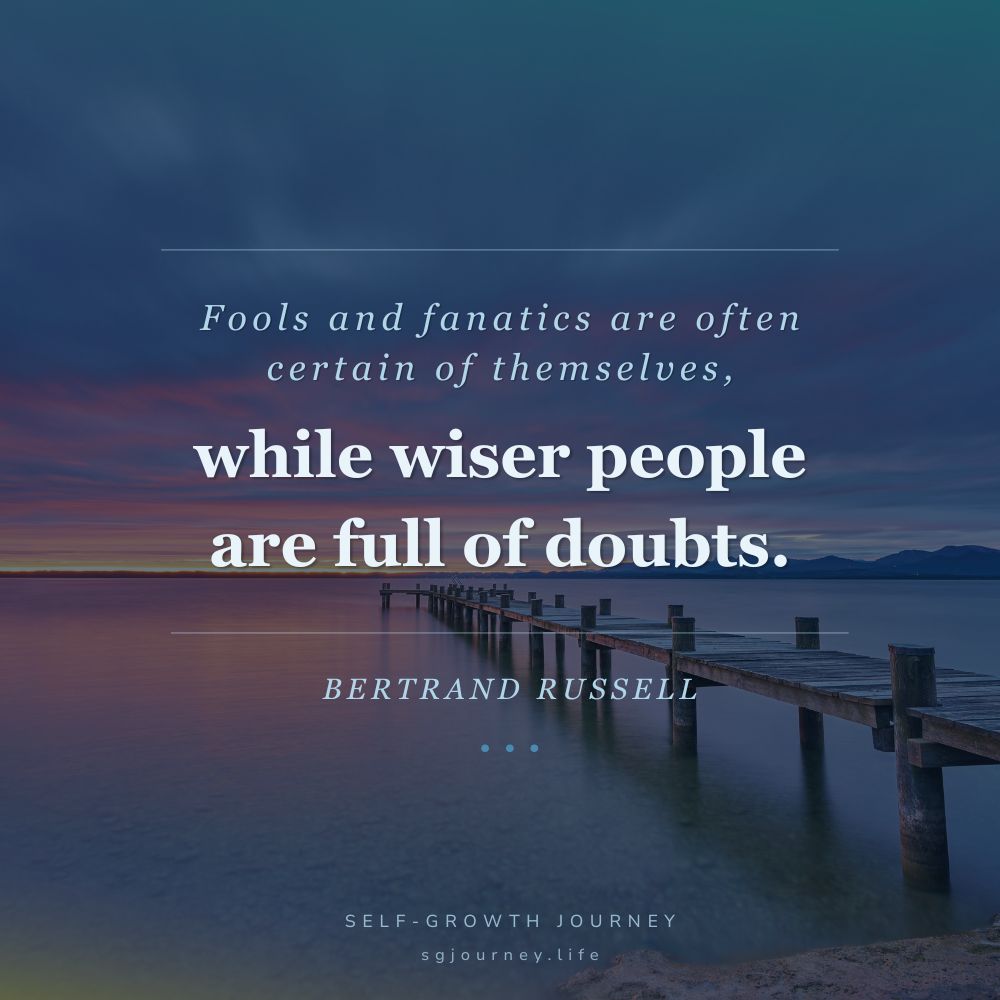
The whole problem with the world is that fools and fanatics are always so certain of themselves, and wiser people so full of doubts.
—Bertrand Russell
Philosopher and logician who defended disciplined doubt
Meet the Giant
Bertrand Russell
Bertrand Russell was a British philosopher, mathematician, logician, essayist, and public intellectual whose work influenced analytic philosophy and modern logic. He also wrote widely about education, politics, war, freedom, and intellectual responsibility, receiving the Nobel Prize in Literature in 1950. This familiar quotation is a later paraphrase of a line in his 1933 essay “The Triumph of Stupidity,” where Russell contrasts the confidence of the foolish with the doubt of the intelligent. The updated wording sharpens his warning but is not his documented sentence verbatim.
What This Means
The quotation suggests that unearned certainty can overpower wiser judgment because thoughtful people are often more conscious of complexity and limitation. It asks us to examine the layer between experience and response: certainty, interpretation, expectation, complication, habitual thought, evaluation, haste, resistance, or untested belief. That layer is often so familiar that we mistake it for reality itself. By noticing it, we recover room to choose how we understand and act.
A responsible reading needs limits. Doubt should not become paralysis, and optimism cannot erase material constraints. Trusting behavior does not require reducing a person to one mistake. Simplifying can remove something essential, while managing thought is not a demand to suppress grief, fear, or justified anger. Observing without evaluation is a temporary discipline, not an instruction to abandon moral judgment. Likewise, accepting change or respecting natural pace does not excuse passivity when action is necessary.
The practical invitation is to pause and separate what is present from what the mind has added. Name the facts, identify the interpretation, and test the certainty. Remove one needless complication, revise one recurring thought, describe an interaction without labels, or allow a process enough time to mature. These are small acts of discernment. Repeated consistently, they help us meet reality with greater humility, steadiness, and freedom rather than being governed by reflexive stories about it.
Why It Matters
This matters because unearned certainty can overpower wiser judgment because thoughtful people are often more conscious of complexity and limitation. Our choices are shaped not only by events but by the confidence, stories, assumptions, and rhythms we bring to them. When those habits remain invisible, we may defend a weak belief, overlook a warning, complicate useful work, rush a developing process, or suffer inside an interpretation that has never been tested.
The quotation offers a practical checkpoint: what is actually here, what have I added, and what response serves reality rather than habit? That question may lead to research, a boundary, a simpler design, a calmer description, a revised expectation, or patient action. It does not promise control over every outcome. It does return responsibility for the quality of our attention and the next choice available to us. Over time, that responsibility builds clearer thinking, healthier relationships, and a life less dominated by automatic reaction.
A Moment of Reflection
What belief do you express with complete certainty? What evidence would genuinely change your mind, and how could you communicate conviction without pretending that doubt has disappeared? What might change if you practiced that distinction for one week?
Carry This With You
Unearned certainty can overpower wiser judgment because thoughtful people are often more conscious of complexity and limitation.
Source & Attribution
Modern paraphrase of Bertrand Russell, “The Triumph of Stupidity” (1933)
Commonly Attributed
Continue exploring the people, ideas, and pillars behind this wisdom.
Explore More Wisdom