
STANDING ON THE SHOULDERS OF GIANTS
Alan Watts on Self-Awareness & Reflection
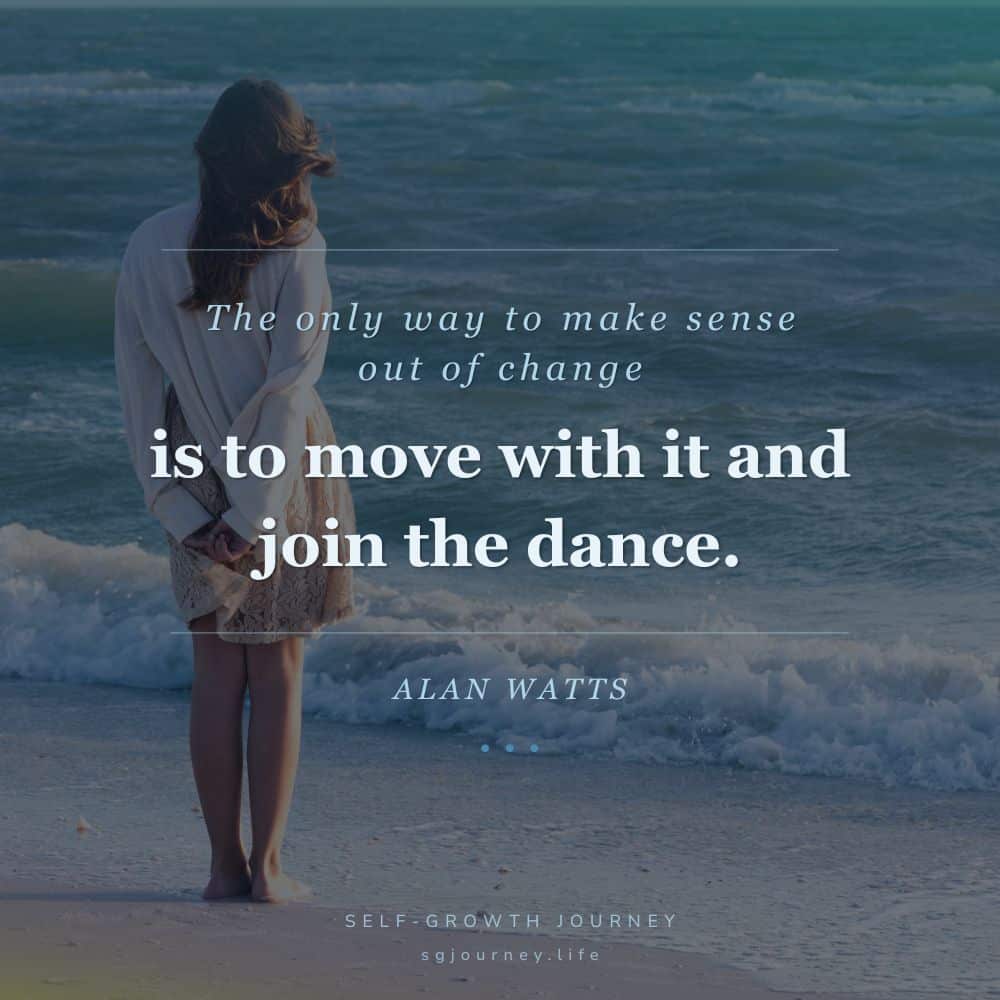
The only way to make sense out of change is to plunge into it, move with it, and join the dance.
—Alan Watts
Philosophical writer who translated Eastern ideas for Western audiences
Meet the Giant
Alan Watts
Alan Watts was a British-born writer, speaker, and interpreter of Asian philosophy who introduced many Western audiences to Zen Buddhism, Daoism, Hindu thought, and nondual perspectives. His books and recorded lectures combined playfulness, metaphor, and criticism of the anxious effort to secure a permanently stable self. In The Wisdom of Insecurity, this quotation uses dance as its central image: change becomes intelligible through participation, not through standing outside life and demanding that motion stop. This context helps connect the thinker to the quotation without overstating what the historical record supports.
What This Means
The quotation suggests that we understand change more fully by participating and adapting than by waiting for life to become still. It shifts attention from the scale or discomfort of the whole situation toward the way we perceive and meet it. The thought becomes useful when it helps us identify a resistance, assumption, distraction, or first action that would otherwise remain invisible.
The insight still needs boundaries. Acceptance is not approval of injustice, introspection does not mean every irritation is our fault, and choosing a response does not grant unlimited control over trauma, emotion, or circumstance. Likewise, elegance can hide necessary complexity, and movement without reflection can become avoidance. Attribution matters too: a valuable sentence should not gain borrowed authority merely because it resembles a famous thinker’s philosophy.
Practically, the quotation asks for one experiment. We might protect an hour, question a familiar premise, sit quietly, adapt to a changing condition, or take the first concrete step. Such actions are small enough to perform and specific enough to teach us something. Repeated over time, they convert wisdom from an admired statement into a way of using attention, meeting uncertainty, and participating more deliberately in our own lives.
Why It Matters
This matters because we understand change more fully by participating and adapting than by waiting for life to become still. People often lose energy by arguing internally with change, repeating a familiar solution, or treating an entire journey as one impossible task. A concise principle can interrupt that pattern and return attention to what is present, knowable, and actionable.
That pause creates room for discernment. We can separate acceptance from passivity, reflection from self-blame, urgency from importance, and the essential next step from the imagined weight of everything still ahead. The resulting action may be quiet: listen, remove a distraction, revise an assumption, protect time, or acknowledge whose work made our own possible. Yet small choices accumulate. They build adaptability, clarity, humility, and momentum while preserving the complexity that a responsible response requires.
A Moment of Reflection
What current change are you observing from the sidelines while hoping it stops? What safe, reversible step would help you participate and learn its rhythm? What small experiment could help you test this insight in daily life?
Carry This With You
We understand change more fully by participating and adapting than by waiting for life to become still.
Source & Attribution
Alan Watts, The Wisdom of Insecurity: A Message for an Age of Anxiety (1951)
Verified
Continue exploring the people, ideas, and pillars behind this wisdom.
Explore More Wisdom